Thursday, March 4, 2010

With a Grain of Salt


Meaning:

To take a statement with 'a grain of salt' or 'a pinch of salt' means to accept it but to maintain a degree of skepticism about its truth.

Origin:
The idea comes from the fact that food is more easily swallowed if taken with a small amount of salt. Pliny the Elder translated an ancient antidote for poison with the words 'be taken fasting, plus a grain of salt'.

Pliny’s Naturalis Historia, 77 A.D. translates thus:

After the defeat of that mighty monarch, Mithridates, Gnaeus Pompeius found in his private cabinet a recipe for an antidote in his own handwriting; it was to the following effect: Take two dried walnuts, two figs, and twenty leaves of rue; pound them all together, with the addition of a grain of salt; if a person takes this mixture fasting, he will be proof against all poisons for that day.

The suggestion is that injurious effects can be moderated by the taking of a grain of salt.

The figurative meaning, i.e. that truth may require moderation by the notional application of 'a grain of salt', didn't enter the language until much later, no doubt influenced by classical scholars' study of Ancient Greek texts like the works of Pliny. The phrase has been in use in English since the 17th century.

Sources:
http://www.phrases.org.uk/meanings/take-with-a-grain-of-salt.html
http://moneyandblogging.files.wordpress.com/2009/06/grain-of-salt.jpg
http://www.american.com/graphics/2008/february-02-08/Salt%20feature.jpg

Steal My Thunder


Meaning:

Someone 'steals your thunder' when they use your ideas or inventions to their own advantage.

To use, appropriate, or preempt the use of another's idea, especially to one's own advantage and without consent by the originator.


Origin:

Devices that produce the sound of thunder have been called on in theatrical productions for centuries. The methods used include - rolling metal balls down troughs, grinding lead shot in bowls, shaking sheets of thin metal. The latter device, called a thunder sheet, is still in use today. The bowl method was referred to in Alexander Pope's literary satire The Dunciad, published in 1728: With Shakespear's nature, or with Johnson's art,
Let others aim: 'Tis yours to shake the soul

Devices that produce the sound of thunder have been called on in theatrical productions for centuries. The methods used include - rolling metal balls down troughs, grinding lead shot in bowls, shaking sheets of thin metal. The latter device, called a thunder sheet, is still in use today. The bowl method was referred to in Alexander Pope's literary satire The Dunciad, published in 1728:

With Shakespear's nature, or with Johnson's art,
Let others aim: 'Tis yours to shake the soul
With Thunder rumbling from the mustard bowl.

John DennisThe story that lies behind 'stealing someone's thunder' is that of the literary critic and largely unsuccessful playwright, John Dennis. In 1704, Dennis's play Appius and Virginia was produced at the Drury Lane Theatre, London and he invented a new method of creating the sound of thunder for the production. We don't know now what this method was (some texts say it was a refinement of the mustard bowl referred to by Pope, in which metal balls were rolled around in a wooden bowl), but it is reported that after Appius and Virginia failed and was closed, the method was soon afterwards used in a production of Macbeth. Dennis was less than pleased at having his idea purloined and this account of his response was recorded by the literary scholar Joseph Spence (1699–1768) and later quoted in W. S. Walsh's Literary Curiosities, 1893:

"Damn them! They will not let my play run, but they steal my thunder."

The actual words are in doubt and are also reported as "That is my thunder, by God; the villains will play my thunder but not my play!". What is clear is that Dennis's experience was the source of this attractive little phrase.

Sources:

http://www.phrases.org.uk/meanings/steal-ones-thunder.html

http://www.thefreedictionary.com/steal+%28someone%27s%29+thunder

http://tinypic.com/view.php?pic=24g7o8o&s=3

Wednesday, March 3, 2010

You're the cat's meow!


Meaning:
Something considered to be outstanding

Origin:
Coined by American cartoonist Thomas a. Dorgan (1877-1929) whose work appears in many American newspapers.


See also "You're the bee's knees!"

Sources:
http://www.xmission.com/~emailbox/phrases.htm
http://images.buycostumes.com/mgen/merchandiser/18021.jpg

You dodged a bullet


Meaning
If someone has dodged a bullet, they have successfully avoided a very serious problem.
To narrowly avoid an unwelcome, harmful, or disastrous outcome or occurrence


Sources
http://www.usingenglish.com/reference/idioms/dodge+the+bullet.html
http://www.merriam-webster.com/dictionary/dodge+the+bullet
https://blogger.googleusercontent.com/img/b/R29vZ2xl/AVvXsEgn75Uz5-nCyHDz6_DgJoYcVeEVAHXsHPFPHU5LXRVK25ReCVcEEeq1CiRWMOzxticIk_idx9gsLNhK0wQoT_nUWnDfJqxbBNz3zxH6cIDBuymkTPiXOfCRit3lKrorY_Fgl-VMBkkovmYC/s320/dodged+a+bullet.jpg
http://blog.therealcostarica.com/wp-content/uploads/2009/04/whew.jpg

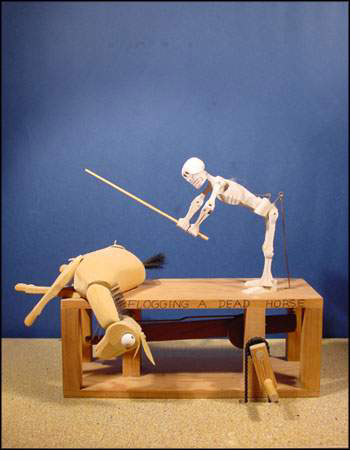
Beating a Dead Horse


Meaning:
If someone is trying to convince people to do or feel something without any hope of succeeding, they're beating a dead horse. This is used when someone is trying to raise interest in an issue that no-one supports anymore; beating a dead horse will not make it do any more work.
"Flogging a dead horse", (alternatively "beating a dead horse") is an idiom that means a particular request or line of conversation is already foreclosed or otherwise resolved, and any attempt to continue it is futile.

Origin:
The first recorded use of the expression with its modern meaning is by British politician and orator John Bright, referring to the Reform Bill of 1867, which called for more democratic representation in Parliament, and about which Parliament was singularly apathetic. Trying to rouse Parliament from its apathy on the issue, he said in a speech, would be like trying to flog a dead horse to make it pull a load.

John Bright

Sources:
http://www.usingenglish.com/reference/idioms/beating+a+dead+horse.html
http://en.wikipedia.org/wiki/Flogging_a_dead_horse
http://swittersb.files.wordpress.com/2009/10/dead-horse.jpg
http://domain1041943.sites.fasthosts.com/holyoake/images/j_bright_1.jpg

Tuesday, March 2, 2010

I Bruise Like a Peach


Meaning:
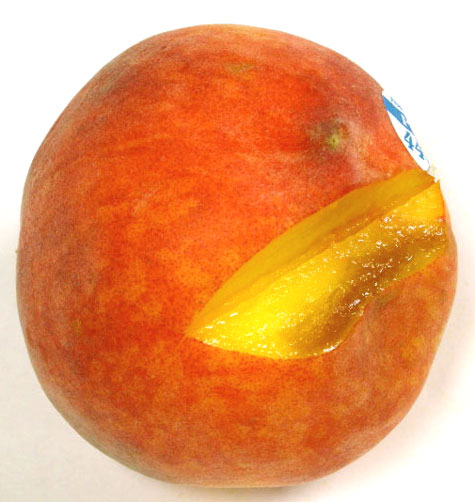
A peach often develops a bruise very easily, just from a little touch. It's the same meaning for a person. If they get a little bump on the arm, they often develop a bruise.
A peach discolors when it is handled roughly. Because peach flesh is soft, it is easily bruised. To bruise like a peach is to quickly and pointedly bruise.

Origin:
The quote "But, but... I bruise like a peach!" is from legendary 80s Van Damme kickbox-a-thon “Bloodsport“, though curiously it has not been deemed a memorable quote by the powers-that-be at IMDB.

Sources:
http://www.englishforums.com/English/BruiseLikeAPeach/vqjqv/post.htm
http://hideyourarms.com/2006/05/24/but-but-i-bruise-like-a-peach/
http://www.ipt.us.com/wp-content/uploads/2009/07/peach-bruise.jpg